
زبان برتر: آموزش زبان انگلیسی
Big Ideas GroupEducation
3.321.00 Reviews
- Version
- 34.0.0
- Installs
- 100.00K
- Age Rating
- Everyone
Screenshots
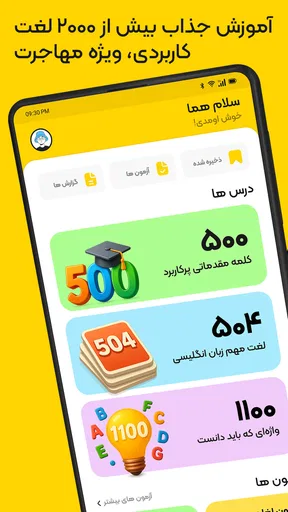
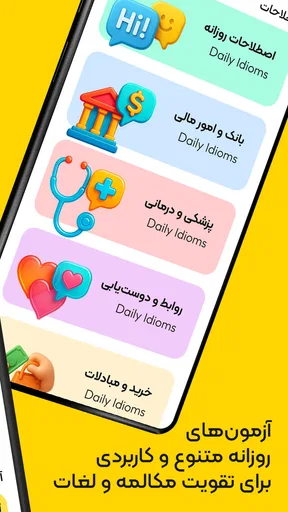
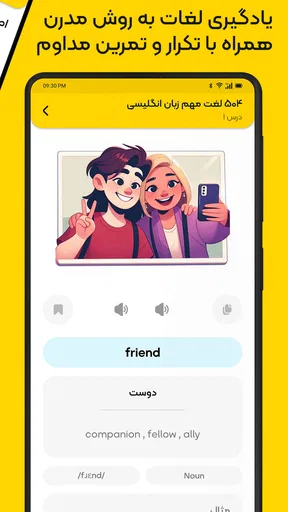
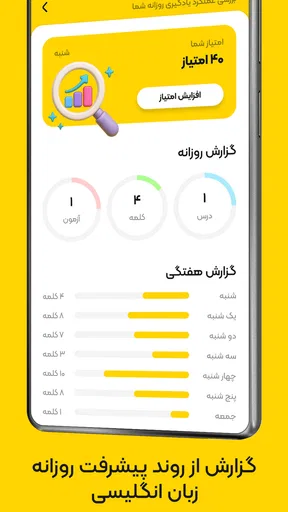
Our Review of زبان برتر: آموزش زبان انگلیسی
 Analysis by Appyee
Learning English is easier when the material matches the way you actually study. I found زبان برتر: آموزش زبان انگلیسی most useful as a practical Persian-language starting point for people who want to build English from the basics and gradually move toward more advanced material. It also puts attention on phrases that can be useful while traveling, which gives the app a more immediate purpose than a lesson tool focused only on grammar.
This is a free education app from Big Ideas Group, available for users aged Everyone. Its store summary presents it as a path from beginner to advanced English, with commonly used travel expressions included in the mix. That combination makes its appeal fairly clear: it is aimed at Persian-speaking learners who want a broad introduction and a quick way to prepare for everyday situations abroad.
How the app feels in everyday use
My first impression is that this is better approached as a study companion than as a complete replacement for a teacher, conversation partner, or structured language course. The app can help you establish a routine, review useful material, and identify areas where your English needs work. It is less convincing if you expect one application to take you from recognizing basic words to speaking naturally in every situation.
The beginner-to-advanced positioning is helpful because it suggests a learner can stay with the same app for a while instead of immediately searching for a second resource. In practice, I would still treat the levels as a guide rather than a formal measurement of proficiency. Finishing material inside an app does not automatically mean that you can understand fast speech, write accurately, or hold a spontaneous conversation.
The travel emphasis is one of the most practical parts of the concept. A learner preparing for an airport, hotel, restaurant, or simple question on the street usually needs complete expressions rather than isolated vocabulary. Studying those expressions in advance can reduce hesitation, especially for someone who understands written Persian explanations more comfortably than English-only instructions.
A realistic routine would be to open the app during a short break, review a small group of travel phrases, and then say each one aloud without looking at the screen. Later, I would try to recreate the same situation from memory: checking into accommodation, asking for directions, or requesting help. That second step matters because passive recognition is much easier than producing a sentence when another person is waiting for an answer.
What the free access means for value
The app is listed as free, so the basic decision is straightforward: you can try it without paying for access. That makes it especially suitable for learners who are still deciding whether a mobile English course fits their habits. It also lowers the risk for occasional users who only want travel preparation or a refresher after a long break.
Free access does not by itself guarantee that the app will cover every need. I would judge its value by how consistently you use the lessons and whether the material matches your goal. Someone who studies regularly and combines the app with listening and speaking practice may get meaningful value from it. Someone who only opens it once in a while may find that even a well-organized collection of lessons does not create lasting progress.
The app has passed the threshold of real-world interest, with over one hundred thousand installs and an average rating of 3.3 from around seven hundred ratings. I would read that as a reason to try it personally rather than as proof that it will suit everyone. The rating is neither a strong warning nor a guarantee of a polished experience, so your own response to the lesson style matters more than the number.
There is no need to treat the free price as a reason to ignore quality. A free learning app still costs you time, attention, and storage space. The sensible approach is to test whether you can understand the explanations, move through the material comfortably, and return to previous lessons without frustration. If those basics work for you, the absence of a purchase cost makes experimentation easy.
Where the learning value is strongest
The strongest use case is guided self-study for Persian-speaking beginners and lower-intermediate learners. Explanations in a familiar language can remove the first barrier that often makes English study feel intimidating. Instead of spending the entire session decoding the instructions, you can focus on the English itself.
The travel material adds value because it connects study with a clear short-term objective. If you have an upcoming trip, you can prioritize expressions that solve immediate problems rather than trying to memorize a large vocabulary list without context. I recommend writing down the phrases that seem most relevant to your own trip and practicing them in both directions: understand the English prompt, then produce the English response.
Another useful workflow is to divide study into three passes. First, read the explanation and identify unfamiliar words. Second, cover the translation and recall the meaning. Third, say the English sentence aloud and change one detail, such as a location, time, or request. This turns a fixed phrase into a flexible pattern. It is a simple technique, but it prevents travel expressions from remaining memorized lines that collapse when the situation changes slightly.
I also see value for learners who need a gentle re-entry into English. After months away from study, a large textbook or advanced speaking platform can feel like too much work. A mobile app with a broad progression can make it easier to restart. The important thing is to use it as a bridge back into learning, not as an excuse to postpone real listening and conversation practice.
Trade-offs that affect the experience
The broad scope is also a limitation. “Beginner to advanced” covers a very large range, and no short mobile session can give equal depth to pronunciation, grammar, vocabulary, listening, writing, and conversation. I would be cautious about assuming that advanced material inside the app represents advanced communicative ability. For serious exam preparation or professional English, a specialized course is likely to be a better fit.
Travel phrases are useful, but they are situational. They can help you order food or ask a basic question, yet they do not replace the ability to understand an unexpected reply. For that reason, I would pair the app with short recordings, real conversations, or videos spoken at natural speed. The app can prepare the sentence you want to say; another resource should prepare you for what the other person may say back.
Self-study also requires discipline. The application cannot make you review yesterday’s material, speak aloud, or correct a weak habit unless you choose to do those things. This is the main trade-off compared with a live class: you gain convenience and privacy, but you lose external accountability. If you often download study apps and abandon them after a few sessions, create a fixed trigger, such as using it after breakfast or during a daily commute.
I would also avoid treating the current version, 34.0.0, as a promise that every part of the experience will feel equally modern or equally deep. Version information tells me which release is current, but it does not replace personal testing. What matters is whether navigation, explanations, and review work smoothly on your device and whether the content keeps you engaged.
The app was released on December 25, 2018, so it has had time to establish a presence rather than appearing as a brand-new experiment. That can be reassuring for someone looking for an existing learning resource, but age can also make consistency important to check. I would spend the first session exploring several levels and topics instead of judging the whole app from one lesson.
Who should use it and who should look elsewhere
I would recommend trying it if you are a Persian speaker starting English, returning to study, or preparing for a trip and wanting useful expressions in one place. It is also a reasonable choice for learners who prefer studying privately and need explanations that do not assume complete comfort with English instructions.
It may be especially useful for someone with a narrow, practical target. Imagine a traveler who has two weeks before departure and feels nervous about basic interactions. That person can focus on greetings, requests, directions, and service situations, then rehearse them aloud every day. The app is valuable in that scenario because it gives the learner a starting structure and reduces the time spent deciding what to study.
I would be less likely to recommend it as the main tool for a learner who already speaks comfortably and wants sophisticated discussion, detailed writing correction, or intensive exam training. In those cases, a tutor, a course built around the relevant exam, or a conversation service will probably deliver more targeted practice. The same applies to learners who need strong pronunciation feedback; reading and repeating phrases is not the same as receiving correction from a listener.
Parents and younger learners should still consider learning style, even though the content rating is Everyone. An age rating describes suitability in broad terms, not whether the explanations will be engaging for a child or whether the progression matches a school curriculum. For a young learner, I would use the app alongside an adult’s guidance rather than expecting it to function as a complete classroom.
How it compares with familiar alternatives
Compared with a traditional textbook, the app is more convenient for short sessions and easier to carry into a travel routine. A textbook may offer more room for extended explanations, written exercises, and careful reference, while this app is better suited to quick review. I would use the app for repetition and immediate phrases, then keep a notebook for examples that need deeper explanation.
Compared with English-only international learning platforms, its Persian-oriented approach may feel more approachable at the beginning. Those platforms often provide richer multimedia ecosystems or stronger speaking communities, but they can also make a beginner spend energy understanding the lesson instructions. The better choice depends on your stage: familiar explanations can be a major advantage early on, while English immersion becomes more important as comprehension improves.
Compared with a private tutor, the free app is far more accessible and flexible, but it cannot adapt in real time to your mistakes or personal goals. A tutor can notice that you understand grammar but hesitate when speaking, or that your pronunciation needs attention. The app cannot offer that same judgment. I see the two as complementary rather than mutually exclusive: use the app to prepare, then use human practice to test what you have learned.
Compared with a phrasebook, this app has the potential to support a wider learning path because it is not limited to isolated travel situations. A phrasebook is excellent when you need one quick sentence, but it rarely helps you build a progression from basic study toward broader ability. The trade-off is that an app asks for repeated practice, whereas a phrasebook can be consulted instantly.
A practical way to get more from it
Start by choosing one purpose instead of opening every topic at random. If your goal is travel, select a small set of situations and master those before moving on. If your goal is general English, begin at a level that feels slightly easy and use it to rebuild confidence. Starting too high can create the illusion that the app is difficult when the real problem is simply that the material does not match your current foundation.
Keep a three-column note beside your study: the English expression, its meaning in your own words, and a new sentence you create. The third column is the important one. It shows whether you understand the pattern or have only memorized the original example. For travel, replace names, destinations, times, and objects so that the expression becomes usable in more than one setting.
Do not measure progress only by how many lessons you finish. A better test is whether you can recall a phrase after closing the app, understand it when spoken at a normal pace, and adapt it to a slightly different situation. If you cannot do those things, repeat fewer items and practice them more actively. This approach makes a free resource far more valuable than passive scrolling.
Use the app as the first layer of a small study system. Add listening for sound, speaking for confidence, and writing for accuracy. Even a short daily routine that combines these activities will expose gaps that an app alone may hide. In my experience, the biggest benefit comes when the application gives structure but does not become the entire definition of learning English.
My recommendation
زبان برتر: آموزش زبان انگلیسی is worth trying for Persian-speaking beginners, returning learners, and travelers who want a free place to begin with everyday English. Big Ideas Group has positioned it in a useful area: a broad learning path with practical travel language rather than a tool limited to one narrow exercise type.
My recommendation is positive but measured. The free price makes the trial easy, and the app can provide real value when you study actively, speak the phrases aloud, and connect them with listening practice. I would not choose it as the only resource for advanced fluency, exam preparation, detailed writing, or personalized pronunciation correction.
If your goal is modest and concrete, such as rebuilding your foundation or preparing for common travel interactions, install it and give it a focused trial. If you already know what kind of advanced practice you need, spend your time with a more specialized alternative. For everyone in between, this is a sensible starting point—as long as you use it to practice English, not merely to read about it.
Verdict
Strengths of زبان برتر: آموزش زبان انگلیسی
- Short lessons make it easy to practice English every day.
- Useful vocabulary focuses on common words and everyday communication.
- Simple exercises support beginners building basic English skills.
- Progress tracking helps users monitor their learning routine.
- Suitable for quick study sessions while commuting or during breaks.
Limitations of زبان برتر: آموزش زبان انگلیسی
- Content may feel too basic for intermediate or advanced learners.
- Limited speaking practice may not improve real conversations enough.
- Some lessons can become repetitive over time.
- An internet connection may be required for certain features.
- The app may offer fewer detailed grammar explanations than full courses.
Similar Picks in This Category
View All
Duolingo: Language Lessons
Duolingo4.7

Google Classroom
Google LLC2.8

Unacademy: Learn & Crack Exams
Unacademy3.2

Bible App for Kids
Life.Church4.4

Cake - Learn English & Korean
Cake Corp.4.7

Brainly: AI Homework Helper
Brainly4.5
Frequently Asked Questions
What is زبان برتر: آموزش زبان انگلیسی, and who is it designed for?
زبان برتر: آموزش زبان انگلیسی is an English-learning app aimed primarily at Persian-speaking users. It provides lessons and practice activities intended to support vocabulary development, grammar, reading, listening, and everyday communication. The app may be useful for beginners and intermediate learners, although the exact experience can depend on the selected course or lesson path. Users should review the available content and level placement before starting.
Does the app include lessons for beginners and advanced English learners?
The app is generally structured to help learners progress through English topics at different levels, with foundational material for users who are starting from the basics and more challenging exercises for those with previous knowledge. However, learners should not assume that every advanced topic is covered in depth. Checking the lesson categories, placement options, and sample content after installation is recommended before choosing it as a complete advanced study program.
What types of English-learning activities are available in the app?
زبان برتر: آموزش زبان انگلیسی focuses on practical learning through lessons and exercises that can help users build vocabulary, understand grammar, and improve their ability to recognize or use English expressions. Depending on the version, some sections may also support listening, pronunciation, or review practice. Because features can change with updates, users should examine the current app description and permissions to confirm which activities are included.
Is زبان برتر: آموزش زبان انگلیسی free to use, or does it require payment?
The application may be available to download without an upfront charge, but some lessons, courses, tools, or additional learning materials could require payment or an in-app purchase. Pricing and access policies can vary by platform and may change over time. Before committing to a course, users should check the store listing, subscription details, trial conditions, and whether advertisements or account registration are required.
Can I use the app without an internet connection?
Offline availability depends on how the app delivers its lessons and media. Some text-based materials may remain accessible after loading, while audio, video, progress synchronization, or certain interactive exercises may require an active internet connection. Users who plan to study while traveling should test a lesson after disabling mobile data and Wi-Fi. It is also wise to confirm whether downloaded content occupies significant storage space.
